Pigeons Under Solar Panels in Texas: What to Check Before Guards Go On
The gap under a rooftop solar array is shaded, sheltered, and hard to reach. To a feral pigeon, it is a ledge with a roof. Here is what a complete fix looks like.
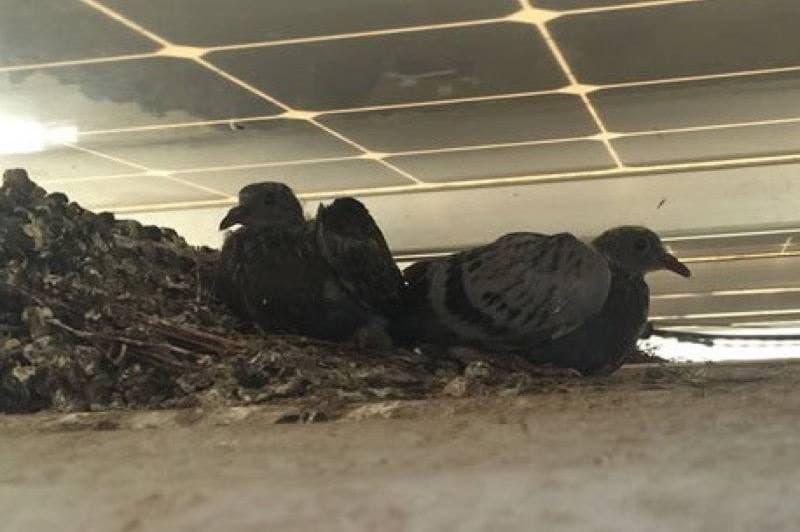
Pigeons nesting under solar panels are one of our common jobs. From the yard, the signs are droppings on the driveway or patio, twigs and nesting debris collecting in the gutter, and birds ducking under the edge of the array. The space between a rooftop array and the shingles is shaded, dry, and hard to get to. For a feral pigeon, it is close to ideal. The fix is a guard around the perimeter of the array, but a guard is the last step of the job, not the first. What happens before it goes on decides whether it works.
Confirm the bird is a pigeon
Feral pigeons, also called rock doves, are not native to the United States. Texas A&M AgriLife Extension says pigeons are not protected in Texas and may be taken at any time, and that their nests and eggs may be destroyed (Texas A&M AgriLife Extension, Managing Feral Pigeons, L-1919). State law says the same thing in its own way: the list of exceptions in Texas Parks and Wildlife Code §64.002 includes the feral rock dove (Tex. Parks & Wild. Code §64.002).
Native doves are another story. Mourning doves and white-winged doves are on the federal list of migratory birds protected under the Migratory Bird Treaty Act (50 CFR 10.13), and Texas law classifies both as game birds (Tex. Parks & Wild. Code §64.001). From the ground, a gray bird flying under a panel edge can be either. A technician confirms the species before any nest comes out.
Document what is under the array
A good inspection starts from the roof, not the driveway. It should establish where the birds are getting in, how far the nesting extends under the panels, and whether there are eggs or young birds (squabs) present. Nesting debris can extend well past the spot where you see birds landing.
Ask for photos of what the inspection finds. They show you the scope before work begins, and they give you a record of the space under the panels, which is hard to see once the guard is installed.
Check with your solar provider before anything is attached
Solar systems come with their own requirements, and the homeowner is the person who knows who installed the system and what paperwork came with it. An older U.S. Department of Energy consumer guide to solar electricity notes that maintenance may be required to comply with a manufacturer's warranty, that most vendors recommend a yearly maintenance check by the installer, and that owners should review the maintenance instructions in the system manual (U.S. DOE, A Consumer Guide to Solar Electricity for the Home).
Before guards go on, it is worth a quick call or email to your installer asking two things: whether they have attachment requirements for third-party guards, and whether they want to be notified of the work. We would rather you have that answer in writing than guess. We are not going to tell you a guard has no effect on your warranty, because that depends on your manufacturer and installer, not on us.
Removal and cleanup come before the guard
Our pigeon control service removes the pigeons, then cleans and sanitizes the area, taking out droppings and nesting material, before guards are installed. The order is not flexible. A guard installed over an active colony traps birds under the array, and one installed over an uncleaned roof seals the mess in.
The cleanup is not cosmetic, either. Texas A&M AgriLife Extension lists histoplasmosis, cryptococcosis, salmonellosis, and several other diseases that pigeons can play a part in transmitting, and it recommends a face mask with a dust filter when handling pigeons in enclosed areas. The CDC says the fungus that causes histoplasmosis lives in soil and also spreads in bird and bat droppings that mix in soil, and that people get sick by breathing in its spores (CDC: About Histoplasmosis). As our pigeon control page notes, droppings are acidic and can damage surfaces, and nesting material can lead to corrosion and even electrical issues.
What a complete guard job covers
When you compare options, these details separate a lasting job from a patch. Use the list with any company you talk to, including us.
- The whole perimeter. Texas A&M AgriLife Extension notes that pigeons tend to remain in the same feeding and roosting areas. Guard only the side where birds were seen, and the same birds can simply use the next open edge.
- Gaps between panel groups. Arrays split across roof planes, or broken up by vents, have inside edges that are easy to miss.
- Cleanup before installation. Ask whether nesting material and droppings under the panels are removed, and how far under the array the crew can reach.
- An attachment method your provider accepts. This is the answer from your installer call.
- Photos of the work. Ask for them. You will want them if the system is ever serviced or the roof is repaired.
- A clear note on what is not included. Roof repairs, panel cleaning, and electrical work on the solar system belong to other trades.
After the guard: a simple maintenance handoff
A guarded array still needs the same maintenance checks your solar provider recommends. The difference is coordination. If a roofer or solar technician needs to work under the panels later, part of the guard may have to come off and go back on. Keep any photos of the work with your solar paperwork, and let whoever services the system know the guard is there before they arrive.
Because pigeons stick to familiar roosting areas, birds that used your roof may keep landing there after the guard is on. A complete perimeter is what keeps them from getting back underneath.
Solar homes across Central Texas
Rooftop arrays in Austin, San Antonio, San Marcos, Temple, and the Hill Country give pigeons the same shaded ledge wherever they are installed. Seeing droppings under the panels or birds slipping beneath the edge? Call (512) 910-3825 or schedule online and we will start with the roof inspection. For Bexar County homes, our San Antonio pigeon removal page has local details.
Frequently asked questions
Are pigeons protected in Texas?
Feral pigeons, also called rock doves, are not native to the United States and are not protected in Texas. Texas A&M AgriLife Extension states that pigeons may be taken at any time and that their nests and eggs may be destroyed, and Texas Parks and Wildlife Code §64.002 excepts feral rock doves from state nongame bird protection. Native doves are different: mourning doves and white-winged doves are federally protected migratory birds and are game birds under Texas law.
Will solar panel guards affect my solar warranty?
Ask your installer or panel manufacturer before anything is attached. An older U.S. Department of Energy consumer guide to solar electricity notes that maintenance may be required to comply with a manufacturer's warranty and tells owners to review the maintenance instructions in the system manual. Your provider's requirements, not a general rule, decide what attachment method is acceptable.
Do the pigeons have to be removed before guards go on?
Yes. The birds, their nests, and the droppings under the array have to come out first. Closing the perimeter with birds or squabs still underneath traps them under the panels, and once the guard is on, the space under the array is hard to reach for cleanup.
Can I clean pigeon droppings off my roof myself?
Texas A&M AgriLife Extension lists histoplasmosis, cryptococcosis, and salmonellosis among the diseases pigeons can play a part in transmitting, and it recommends a face mask with a dust filter when handling pigeons in enclosed areas. The CDC says the fungus behind histoplasmosis lives in soil and also spreads in bird and bat droppings that mix in soil. Add roof height and hot panels, and this is a job better left to a crew with the right protective equipment.
Related reading
Wildlife in your home? Contact us today.
Call for a phone consultation.